
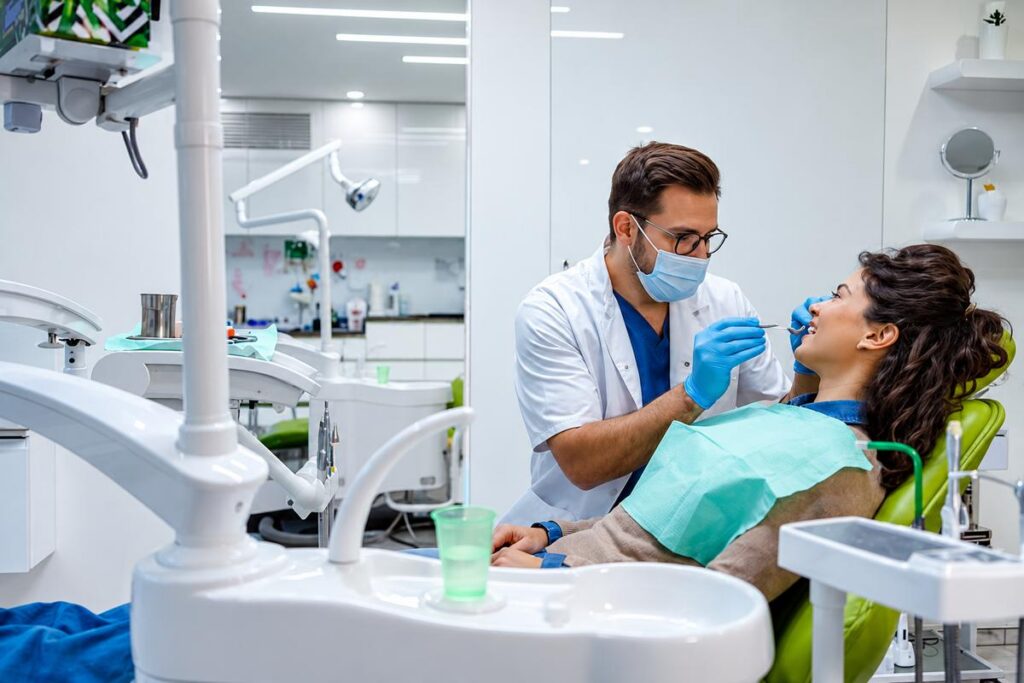
How Dentists Rebuild a Collapsed Bite With Full Mouth Reconstruction
Dentists rebuild a collapsed bite by finding out why bite support was lost, deciding whether bite height needs to change, testing that change with temporary restorations, and then restoring the teeth with crowns, bridges, or implants designed to work together.
When teeth become severely worn, damaged, or missing, the upper and lower jaws may no longer meet with the stable contacts they once had. Your bite may feel uneven. Chewing can take more effort, and the teeth you still have may carry more pressure than they were built for.
A collapsed bite is not always a simple matter of the jaws moving closer together. A dentist has to determine whether you have truly lost vertical dimension, lost support from your back teeth, or developed shifting and over-erupted teeth over time.
Full mouth reconstruction brings those answers together. As part of comprehensive restorative dentistry, it can rebuild the back teeth, establish an appropriate bite relationship, and restore damaged or missing teeth. For patients in Pennington and across Mercer County, that process starts with a careful bite rehabilitation evaluation at Lawrenceville Smiles in Lawrenceville, NJ.
What Is a Collapsed Bite, and What Does It Mean for Your Teeth?
“Collapsed bite” is an everyday term for a bite that has lost its stable support, usually because back teeth are missing or severely worn. Dentists assess it by examining posterior support, tooth wear, and the vertical dimension of occlusion (VDO), the jaw relationship when your teeth meet.
That clinical assessment matters. Worn teeth alone do not prove you have lost VDO, and the difference shapes the entire treatment plan.
How the Upper and Lower Teeth Normally Maintain Bite Support
Occlusion is simply the way your upper and lower teeth fit together when you close. In a stable bite, the molars and premolars meet firmly and carry most of the chewing load.
Those back teeth work like the pillars of a building. They hold the jaws at a consistent position and spread chewing forces across many teeth instead of a few.
The front teeth have a different job. They cut food and guide the jaw as it slides forward or side to side. When both groups do their work, no single tooth takes more force than it can handle.
What Happens When Back Teeth Are Missing or Severely Worn?
Losing molars or premolars removes some of those pillars. Chewing shifts to whatever teeth remain, and the front teeth often absorb forces they were never designed to carry.
Other changes can follow. Neighboring teeth may tip into open spaces. An opposing tooth with nothing to bite against can drift further out of its socket, a process called compensatory eruption. Contacts become uneven, and chewing on one side may start to feel easier than the other.
Not every patient with missing molars develops these problems, and the pace varies. But reduced bite support is one of the most common findings in patients who describe their bite as collapsed.
Does a Collapsed Bite Always Mean You Have Lost Bite Height?
No. As teeth slowly wear down, the body often compensates. Teeth can keep erupting and the supporting bone can adapt, which may hold the jaws at roughly the same distance apart even though the teeth look shorter.
So a worn smile does not automatically prove a loss of vertical dimension. Before deciding whether bite height should change, a dentist evaluates the actual jaw relationship, the space available for restorations, the pattern of wear, and any functional symptoms.
How Dentists Diagnose a Collapsed Bite Before Reconstruction
Dentists diagnose a collapsed bite by examining the whole chewing system: the teeth, existing dental work, jaw movement, muscles, and joints. The goal is to understand why support was lost, not only which teeth look damaged, because the cause shapes every treatment decision.
Many patients arrive after years of repairs that kept failing. As our article on how bite problems affect dental restorations explains, new crowns placed into an unstable bite tend to fail the same way the old ones did.
Evaluating Tooth Wear, Missing Teeth, and Existing Restorations
The exam starts with a detailed record of your mouth as it is today. That includes worn or fractured teeth, cracked fillings, broken or poorly fitting crowns, failing bridges, and gaps where back teeth used to be.
Each tooth then gets an honest judgment. Does it have enough healthy structure, gum support, and bone support to hold a restoration for years? Or is it likely to fail under the forces of a rebuilt bite?
Those answers decide which teeth stay, which get crowns or onlays, and which may need replacement.
Measuring Vertical Dimension and Available Restorative Space
Every crown or onlay needs a physical room. If the teeth have worn down while the jaws stayed at the same distance, little space may remain between the upper and lower teeth for new restorations.
To judge this, dentists combine several sources of information: facial measurements, clinical records, photographs, speech, facial appearance at rest, and how comfortably you function. No single facial measurement reveals the right bite height. The answer comes from how these findings fit together.
Examining Jaw Movement, Muscle Function, and Bite Contacts
The dentist also watches how your jaw opens, closes, and slides from side to side. They check where the teeth touch, whether some teeth hit first, and whether the jaw muscles or joints are tender.
Jaw pain deserves a careful look, but it is not proof of a collapsed bite. The National Institute of Dental and Craniofacial Research describes temporomandibular disorders as a group of more than 30 conditions affecting the jaw joints and chewing muscles. Restorative treatment is not a guaranteed solution for TMD, and a good evaluation keeps those two issues separate.
Using Diagnostic Models and Digital Records to Plan Rehabilitation
Before any tooth is prepared, the dentist can study your bite outside your mouth. Dental scans or impressions, photographs, and models mounted to reflect your jaw relationship show how the teeth meet from angles that are hard to see in the chair.
A diagnostic wax-up or digital setup can then preview the proposed restorations. This lets the dentist test tooth shapes and bite height on a model first, and it lets you see the plan before treatment begins.
How Dentists Determine the Correct Bite Height for Full Mouth Reconstruction
Dentists determine bite height by weighing function, facial anatomy, available restorative space, and how well you adapt to a proposed change. Choosing a new vertical dimension is a clinical planning decision. It is never about simply making the teeth look longer.
Understanding Vertical Dimension of Occlusion
VDO describes how far apart your upper and lower jaws are when your teeth, or your restorations, are in contact. Think of it as the closed height of your bite.
It matters because it sets how thick restorations can be, how long the teeth appear, and how the front and back teeth relate during function. Change the VDO and you change all three.
Why Increasing Bite Height Is Not Always Necessary
Many worn smiles can be rebuilt at the existing bite height. When there is enough space for durable restorations and the jaw relationship is stable, the dentist may restore lost tooth shape without opening the bite at all.
The distinction is simple. Restoring worn tooth anatomy puts back the shape of each tooth. Increasing VDO changes how the jaws relate to each other. Some cases need the first, some need both, and the exam shows which.
How Clinicians Evaluate a Proposed New Jaw Relationship
When a change looks appropriate, the dentist checks the proposed position from several directions. These include jaw relationship records, occlusal analysis, speech, comfort, facial appearance, and whether the restorations can actually be built well at that height.
Clinicians use different techniques to record jaw position, and no single method is right for every patient. What matters is that the chosen position suits your anatomy and your function.
Why Bite Height Changes May Be Tested Before Final Treatment
A new bite height is a working plan until you live with it. Provisional restorations or other reversible trial methods let the dentist see how you handle the change before anything permanent is made.
During that trial, the dentist monitors comfort, speech, chewing, tooth contacts, and how the temporary restorations hold up. A problem found here is far easier to correct than one discovered after final crowns are placed.
Rebuilding Posterior Support: Why Back Teeth Are Central to Bite Rehabilitation
Back teeth are central because molars and premolars provide the main stopping points when your jaws close. Without them, the bite has no stable foundation, and new restorations on the front teeth would carry forces they cannot withstand for long.
Rebuilding Worn Molars and Premolars With Crowns or Onlays
When natural back teeth are worn but restorable, crowns or onlays can rebuild their chewing surfaces. The goal is to restore the cusps, contacts, and height that give the bite firm, predictable stops.
Material choice matters, but it comes second. A strong material with the wrong shape or contact will still fail, so the bite design leads.
Replacing Missing Back Teeth With Dental Implants or Bridges
When the back teeth are already gone, that support has to be replaced. Dental implants for missing back teeth can restore those stopping points without relying on neighboring teeth. A tooth-supported bridge may be a sound choice when the teeth on either side of a gap already need crowns.
The decision depends on the health of your remaining teeth, the bone available, the long-term outlook for each option, and how the replacement fits the overall bite design.
What Happens When Both Sides of the Back Teeth Need Reconstruction?
When support is missing on both sides, the bite has nothing stable to close against. Fixing one tooth at a time rarely solves this, because each new restoration gets built to an unstable position.
Instead, the dentist plans both sides together, often across the upper and lower arches, so every restoration targets the same bite. This coordination is a major reason collapsed-bite cases call for full mouth planning rather than isolated repairs.
How Posterior Restorations Influence Front-Tooth Function
Firm back-tooth contacts can take pressure off the front teeth when you close. That lets the front teeth return to their intended role of guiding jaw movement, known as anterior guidance.
Still, rebuilding the back teeth does not automatically stop front-tooth wear or grinding. Habits, diet, and other factors keep playing a role, so the front teeth need their own evaluation.
How Full Mouth Reconstruction Rebuilds a Stable, Functional Bite
Full mouth reconstruction rebuilds a stable bite by coordinating every restoration around one shared plan. Crowns, onlays, bridges, and implants are designed to work together at the chosen bite height, instead of being placed one at a time to patch visible damage.
Preserving Natural Teeth That Can Support the New Bite
Keeping suitable natural teeth is often part of a successful reconstruction. A tooth with enough remaining structure and solid gum and bone support can anchor a crown for many years.
Each tooth’s prognosis is weighed honestly. A tooth likely to fail soon can become a weak link in a rebuilt bite, while a strong tooth may be worth more than any replacement.
Restoring Damaged Teeth With Crowns, Onlays, and Bridges
In a reconstruction, each restoration is one part of a system. Tooth shape, the contact points between neighbors, the chewing surfaces, and how each tooth meets its opposite all need to agree.
A crown that looks perfect on its own can still cause trouble if it touches too early or too hard. That is why the restorations are designed together and checked together.
Using Dental Implants to Replace Missing Structural Support
Implants can restore back-tooth support or replace teeth that cannot be kept. In a collapsed bite, they often provide the posterior stops the rest of the plan depends on.
Implant placement should follow the planned final restorations, not the other way around. When the implant position is chosen with the final crown in mind, that crown can be built to support the bite correctly.
When Extensive Tooth Loss Requires Full-Arch Rehabilitation
Some patients have too few healthy teeth left to restore one by one. For them, a fixed full-arch implant restoration such as All-on-4, or a denture-based option, may be considered.
The same bite principles still apply. The new arch has to be built at an appropriate height with stable contacts. Dr. Michael Scalia can help you weigh whether a full-arch approach fits your situation after a full evaluation.
How Dentists Balance Chewing Forces Across the Reconstructed Bite
Dentists balance chewing forces by designing contacts so the load spreads across the reconstructed bite instead of concentrating on a few teeth or implants. Filling every gap is only part of the work. The restorations also have to function together under daily chewing and clenching.
Creating Appropriate Contacts Between Upper and Lower Teeth
The dentist checks contacts both when you close and when your jaw moves. In a stable bite, the back teeth meet evenly and steadily on closing.
That does not mean every tooth carries identical force. It means no single tooth or implant takes a heavy hit that the others are spared.
Designing the Bite Around Natural Teeth and Dental Implants
Natural teeth and implants respond to pressure differently. A natural tooth sits in a periodontal ligament, a thin cushion of fibers that lets it move very slightly and sense pressure.
An implant fuses directly to the jawbone through osseointegration. It is far more rigid and gives less feedback. In a mixed reconstruction, the dentist accounts for that difference, often adjusting implant crown contacts so implants do not take the first or heaviest load when you bite.
Accounting for Grinding and Clenching During Reconstruction
Grinding and clenching place heavy force on teeth and restorations. According to the National Institute of Dental and Craniofacial Research, severe bruxism can leave teeth flattened, chipped, cracked, or loose.
For patients who grind, that history influences restoration design, material selection, and whether a protective nightguard is prescribed. Our article on how grinding affects worn teeth covers that side of the problem in more detail.
Reconstruction does not cure bruxism. It rebuilds the teeth, and protecting them afterward remains part of the plan.
Why Front-Tooth Guidance Matters During Jaw Movement
Anterior guidance describes how the front teeth steer the jaw as it moves. Slide your jaw to one side, and in a well-designed bite the canines on that side take over while the back teeth separate slightly.
That brief separation protects the back teeth from sideways forces they handle poorly. The plan builds this guidance into the front teeth so the whole bite shares the work.
Why Temporary Restorations May Be Used Before the Final Bite Is Rebuilt
Temporary restorations let you test a new bite before the final restorations are made. In complex cases, especially when bite height changes, provisionals act as a working trial that shows how the design performs during real chewing and speaking.
Testing the New Bite During Everyday Activities
You eat, talk, and go about your normal routine in provisional restorations, often for several weeks. That real-world use reveals what a model cannot.
The dentist wants to know whether certain sounds feel different, whether chewing feels balanced on both sides, and whether your jaw muscles stay comfortable.
Adjusting Tooth Shape, Height, and Contacts Before Final Restorations
Provisionals are easy to modify. The dentist can reshape edges, refine contacts, or adjust height based on how you are doing.
Once the provisional design works well, it becomes the blueprint for your final restorations.
What Happens if the Trial Bite Feels Uncomfortable?
Tell your dentist. Discomfort during the trial phase is useful information, and it should be evaluated rather than ignored.
Adjustments often resolve it. Sometimes the plan needs to be reconsidered, including the proposed bite height. Not every patient adapts to an increased VDO, and the trial phase exists to find that out before anything permanent is made.
What Does the Full Mouth Reconstruction Process Look Like for a Collapsed Bite?
Most collapsed-bite reconstructions move through five phases: examination and bite analysis, stabilizing oral health, rebuilding support and testing the bite, completing final restorations, and long-term maintenance. The exact sequence and timeline depend on your teeth and your goals.
Phase 1: Comprehensive Examination and Bite Analysis
Your first visit includes a full exam, imaging when indicated, a prognosis for each tooth, and a conversation about your goals. For patients coming from Ewing, Princeton, or elsewhere in Mercer County, this is where the whole picture of the bite comes together.
Phase 2: Stabilizing Oral Health and Preparing the Teeth
Active problems come first. That can mean periodontal treatment, managing decay, and deciding about teeth that cannot be saved. Restorations last longer on a healthy foundation.
Phase 3: Rebuilding Support and Testing the Bite
Teeth are prepared and provisional restorations placed. When implants are part of the plan, they are placed and given time to heal. The bite is then tested and refined as needed.
Phase 4: Completing Final Restorations and Occlusal Adjustments
Final crowns, bridges, or implant restorations are made from the approved provisional design. The dentist verifies the contacts, checks function, and fine-tunes the bite for comfort.
Phase 5: Maintenance and Protection of the Reconstructed Bite
Regular checkups and cleanings protect the investment you have made. Your dentist monitors wear over time and may prescribe a nightguard if you grind or clench.
When Should Mercer County Patients Consider an Evaluation for Bite Reconstruction?
Consider an evaluation if you have several worn or repeatedly repaired teeth, missing back teeth, or a bite that feels short or uneven. These signs warrant a closer look, but they do not establish a diagnosis. Only an examination can do that.
Multiple Worn, Cracked, or Repeatedly Repaired Teeth
One cracked tooth is usually just one cracked tooth. When several teeth keep chipping, cracking, or needing new fillings, the pattern may point to a bite problem rather than a string of bad luck.
Missing Back Teeth and Difficulty Chewing Evenly
If you chew mostly on one side or avoid certain foods because back teeth are missing, your bite support may be reduced. A functional assessment can show how much that loss is affecting the rest of your teeth.
A Bite That Feels Shorter, Uneven, or Difficult to Close Comfortably
Some patients say their teeth feel shorter or that they cannot find a comfortable way to close. These sensations can have several causes, including wear, shifting teeth, or jaw muscle tension, so an exam is the only way to sort them out.
Existing Crowns or Bridges That No Longer Work Together Comfortably
Dental work placed years apart, by different dentists, may not share the same bite plan. If older crowns or bridges feel high, wear unevenly, or keep loosening, a full evaluation looks at how they relate to each other and to your natural teeth.
FAQs About Collapsed Bite Reconstruction
Can a collapsed bite be corrected without dental implants?
Yes, in many cases. If the missing teeth can be replaced with bridges or your remaining teeth are restorable with crowns or onlays, implants may not be needed. The right approach depends on how many teeth are missing and how healthy the remaining teeth are.
Does rebuilding a collapsed bite require treating every tooth?
Not always. Full mouth reconstruction often involves many teeth, but the extent of treatment is individual. Some patients need work on most teeth in both arches, while others need targeted restorations that bring the existing bite back into balance.
Can dentists restore lost bite height?
Yes, when it is clinically appropriate. Dentists can change the vertical dimension of occlusion with crowns, onlays, or implant restorations. Many worn smiles, though, can be restored without increasing bite height at all.
How do dentists know what bite height is right?
They combine several sources of information rather than relying on one number. These include facial and clinical measurements, records of your jaw relationship, speech, appearance, and available restorative space. In complex cases, provisional restorations test the proposed height before final treatment.
Can full mouth reconstruction improve chewing ability?
It often can. Restoring back-tooth support and stable contacts may make chewing more efficient and more even from side to side. Results vary from patient to patient, and your dentist can explain what is realistic for your case.
Will rebuilding my bite stop teeth grinding?
No. Bruxism is a separate condition that may need its own management, such as a nightguard. Reconstruction rebuilds and protects the teeth, but it does not cure grinding.
Can a collapsed bite affect the appearance of my face?
It can. Lost tooth support and severe wear may reduce lip support and change the proportions of the lower face. Restoring the bite can improve tooth display and support, though it is a dental treatment and not a facial rejuvenation procedure.
Where can patients from Pennington get evaluated for complex bite rehabilitation?
Lawrenceville Smiles, located at 132 Franklin Corner Road in Lawrenceville, is a short drive from Pennington. Dr. Michael Scalia evaluates the full bite, including worn teeth, missing teeth, and existing restorations, before recommending any treatment.
Explore Full Mouth Reconstruction Near Pennington, NJ
A stable bite comes from a plan built around your teeth, your jaw relationship, and the way you function. It does not come from adding height to a few teeth and hoping for the best.
At Lawrenceville Smiles, Dr. Michael Scalia evaluates the causes behind a collapsed bite and designs restorative care around what your mouth actually needs. Our office in Lawrenceville serves patients from Pennington, Princeton, Ewing, and surrounding Mercer County communities.
If your bite feels uneven, your teeth keep breaking, or you are missing back teeth, schedule an evaluation at Lawrenceville Smiles or call (609) 557-3595.

Categories: Restorative Dentistry | Published: October 26, 2026
